
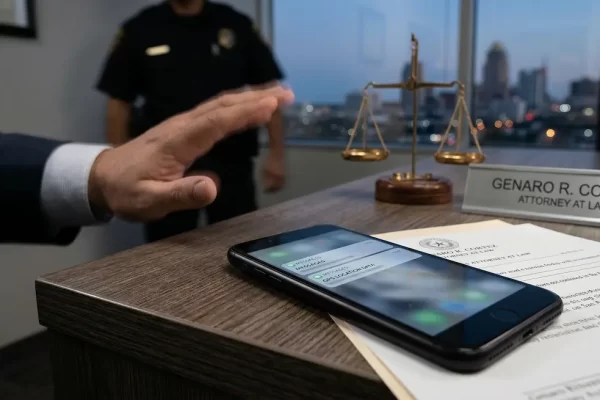
If you are facing federal alien smuggling charges in San Antonio, Del Rio, or South Texas, the digital evidence on your cell phone—like WhatsApp messages and GPS pin drops—is often the prosecution’s “star witness.” Understanding that police generally cannot search your device without a warrant is the first step in protecting your Fourth Amendment Amendment rights and building a strong legal defense.
Key Takeaways: Your Phone & Alien Smuggling Stops
- The “Get a Warrant” Rule: Under Riley v. California, police generally cannot search your phone without a warrant, even after an arrest.
- Consent is a Trap: If you say “Yes,” you waive your 4th Amendment rights. Anything found (WhatsApp, GPS, Zelle) will be used against you.
- Be Firm but Polite: If asked, say: “I do not consent to a search of my phone. I want to speak to my lawyer and I will remain silent.”
- Digital Evidence: Federal prosecutors use GPS pin drops and text messages as “star witnesses” to prove intent in smuggling cases.
Why Your Cell Phone is the “Star Witness” in Federal Smuggling Cases
Cell-phone evidence is a gold mine for prosecutors in alien smuggling cases in San Antonio, Del Rio, and South Texas. It gives the government everything they need to prove the suspect intended to transport aliens from the Del Rio border and farther into the United States. Similarly, it often proves the suspect joined a criminal conspiracy to smuggle migrants.
The phone contains GPS directions and pin drops for pickup locations, photos showing which car is picking up the migrants, WhatsApp text messages talking about the crime, and Zelle receipts paying for gas and hotel rooms. Once police get this information from a suspect’s phone, then their chances of conviction skyrocket.
But what are your rights if police want to search your cellphone if they suspect you are smuggling migrants in San Antonio, Del Rio, Laredo, Austin, or Houston? We answer these questions and explain how a lawyer will defend you at trial if police search your cellphone.
Can the Police Search Your Phone Without a Warrant in the Western District of Texas?
No. Police cannot search your cell phone without a warrant unless you consent to a search. Consent means you give police permission to look through your device even if they do not have a legal reason to search it. Once you do this, police no longer need probable cause or a warrant to search. If they find something that incriminates you, then police can use it at trial.
The Supreme Court’s “Get a Warrant” Rule (Riley v. California)
The Fourth Amendment requires police to get a warrant to search your phone. This requirement protects your personal privacy rights in the following types of information:
- Medical records and apps on your device;
- Political and personal associations and contacts; and
- Intimate videos, photos, and texts;
Therefore, to protect your privacy rights, the Constitution requires police to have probable cause to search your phone and they need to get a warrant to search it.
The Supreme Court is explicit on this issue:
Modern cell phones are not just another technological convenience. With all they contain and all they may reveal, they hold for many Americans “the privacies of life[.]” . . . The fact that technology now allows an individual to carry such information in his hand does not make the information any less worthy of the protection for which the Founders fought. Our answer to the question of what police must do before searching a cell phone seized incident to an arrest is accordingly simple—get a warrant.
Riley v. California, 573 U.S. 373, 403 (2014).
In short, federal courts in the Western District of Texas must make sure that police got a warrant supported by probable cause to search your phone. If they did not, then the judge will exclude the evidence unless prosecutors can provide an exception to these requirements.
One exception is a consent search.
What to Do If Police Ask for Consent to Search Your Phone During an Alien Smuggling Traffic Stop
The rule is simple, but the reality in San Antonio, Del Rio, and South Texas is challenging. Police will minimize the consequences of their request to search your phone. They will ask you if they can look at your phone messages and pin drops? However, they do not tell you that if they find something incriminating on your phone that they will use it against you at trial.
Here is what you tell police if they ask for consent to search your phone: I do not consent to a search of my phone. Please get a warrant. Then ask for a lawyer and tell them you will remain silent until you speak with a lawyer. Finally, stop talking.
See Riley v. California, 573 U.S. 373 (2014).
That is the rub with cell phone searches in alien smuggling cases in the Western District of Texas. In most cases, the cell phone evidence becomes the “star witness” in your case. The cell phone evidence will tell the jury who you texted, what you talked about, how much you were paid, and where you picked up the migrants. This type of evidence makes your case harder to defend.
For that reason, if police ask to search your phone after they arrest you for a human smuggling crime in the Western District of Texas, then tell them no. Be respectful. Be polite. But be firm.
Arrested in San Antonio or Del Rio?
If the police have already seized your phone or vehicle, the next 24 hours are critical for your defense. Don’t wait for the government to build their case using your private data.
How Federal Prosecutors Use Digital Evidence Under 8 USC § 1324
Once police get your consent to search your phone, they will look for the following digital evidence:
- WhatsApp Text messages showing who you talked to
- Zelle or CashApp payments for gas and hotel fees
- GPS pin drops showing where you picked up the migrants
- Apple voice messages talking about smuggling migrants
- GPS route trackers that show which way you drove
- GPS routes the migrants walked while they were in the brush
- Pictures of your car you sent to the migrants
Surprisingly, police in the Western District of Texas compare the evidence on your phone with the evidence on the cell phones of the migrants. If it matches or overlaps, then the prosecutors will show it to the jury to prove you intentionally smuggled migrants.
CRITICAL: Your 4th Amendment Rights
If police ask to search your phone, follow these three steps immediately:
- Be Respectful but firm: Tell the officer, “I do not consent to a search of my cell phone. Please get a warrant”.
- Invoke Your Silence: State clearly that you will remain silent until you speak with your lawyer.
- Stop Talking: Do not try to “explain” your way out of the situation. Anything you say about GPS pin drops or WhatsApp messages can be used as the “star witness” against you at trial.
Learn more about how we defend alien smuggling cases in the Western District of Texas.
Challenging Illegal Searches in San Antonio and Del Rio Federal Court
Once police search your cell phone, we must fight to get a federal judge to keep this evidence out of your trial. Your defense attorney will check if police got a warrant to search your device. If they did not get a search warrant and you did not consent to a search, then your attorney will file a motion to suppress this evidence.
Another related issue with consent searches is if you voluntarily consented to the search. This happens when the totality of the circumstances show that police pressured or forced you to consent to the search. See United States v. Soriano, 976 F.3d 450, 455 (5th Cir. 2020). These are difficult motions to fight because in many cases the defendant cooperates with police hoping that it will help their case. Nevertheless, your attorney must check if you consented to the search and if it was voluntarily given.
Call a San Antonio and Del Rio Human Smuggling Defense Attorney Today
Since 2003, Attorney Genaro R. Cortez has filed motions to suppress in San Antonio and Del Rio federal court challenging police searches in alien smuggling cases across South Texas. This includes fighting cell phone searches and advising clients on the best course of action for their cases.
If you have an 8 USC § 1324 smuggling charge in San Antonio, Del Rio, or South Texas, then call today for a free case evaluation.
View our full guide on Texas Smuggling of Persons Laws.
FAQs about phone searches in alien smuggling cases
Can police search my cell phone during a traffic stop in Texas?
No. Under the Supreme Court’s ruling in Riley v. California, police must get a warrant before searching your cell phone. This applies whether you are stopped on a highway in Del Rio, San Antonio, or anywhere else in South Texas. The only exception is if you give police your consent to search.
What happens if I say yes when police ask to look at my phone?
Once you consent to a search, you waive your Fourth Amendment rights. Police no longer need a warrant, and anything they find — WhatsApp messages, GPS pin drops, Zelle payments — can be used against you at trial. However, you can revoke your consent at any time during the police search.
Can my attorney get cell phone evidence thrown out of court?
Yes, in some cases. If police searched your phone without a warrant and without your consent, your attorney can file a motion to suppress that evidence. If the judge grants the motion, prosecutors cannot use it at trial. However, if you voluntarily consented to the search, suppression becomes much harder to win.
What digital evidence do federal prosecutors look for in alien smuggling cases?
Prosecutors in the Western District of Texas typically look for WhatsApp messages, GPS routes and pin drops, Zelle or CashApp payment records, voice messages, and photos shared with migrants. They also compare the evidence on your phone against the phones of the migrants themselves to establish a connection.
What should I say if police ask for my phone password or PIN?
I do not consent to a search of my cell phone. Then ask for a lawyer and remain silent. If you give them this information, then a judge may conclude that you consented to a search of your cell phone.
Does it matter if the smuggling case is state or federal when it comes to phone searches?
The Fourth Amendment applies in both state and federal court, so the warrant requirement is the same.