

What Is a 922(g)(1) Federal Gun Charge?
A 922(g)(1) charge is one of the most serious federal gun crimes a person can face.
If you have a prior felony conviction and were found with a firearm, the federal government
can charge you under 18 U.S.C. § 922(g)(1) — the felon-in-possession statute. A conviction
carries up to 10 years in federal prison. If you have three prior violent felonies or serious
drug offenses, that minimum jumps to 15 years under the Armed Career Criminal Act.
But a charge is not a conviction. These cases have real, documented weaknesses — and the
outcome depends heavily on whether the government can actually prove you knowingly possessed
the firearm. This article explains how the law works, what the penalties look like, and where
these cases can be successfully challenged.
Facing a 922(g)(1) charge in San Antonio or Bexar County?
Attorney Genaro Cortez has handled federal gun cases for over 20 years. Get a free case evaluation — available in English and Spanish.
☎ Call (210) 733-7575 Free Consultation →What Does It Mean to “Possess” a Firearm Under Federal Law?
To possess a gun, you must have knowledge and control over the gun. In other words, you must know about the gun and control it either directly or indirectly. This is where the 922g1 gun law gets tricky.
Usually in a 922g1 gun case, there is no dispute that the person has a felony record. And there is no dispute that the gun is a firearm. So these cases turn on two things. What did the person know about the gun? And what did the person do to control the gun?
The answers to these two questions will lay the ground work for a 922g1 gun defense. To understand why, we first need to look at legal definition for “possession” and then review the elements for this gun crime.
Definition of “possession” in a 922(g)(1) gun case.
| No. | Definitions of Possession. |
|---|---|
| 1. | Possession means either actual or constructive possession. |
| 2. | A person who knowingly has direct physical control over a thing, at a given time, is in actual possession of it. |
| 3. | A person who, although not in actual possession, knowingly has both the power and the intention, at a given time, to exercise dominion or control over a thing, either directly or through another person or persons, is in constructive possession of it. |
| 4. | Possession may be sole or joint. If one person alone has actual possession or constructive possession of a thing, possession is sole. If two or more persons share actual or constructive possession of a thing, possession is joint. |
Examples of being in possession of a firearm.
Notably, the definition above is provided by the Fifth Circuit Court of Appeals. But to see how this law works, it is helpful to look at a few examples. For instance, a person is in possession of a gun if:
- he has a gun in his pocket;
- police see him carrying a gun; or
- police link the person to the gun with fingerprint or DNA evidence.
Above all, the key to this crime is control. The person must be in control of the gun to be guilty of a 922(g)(1) gun crime. On top of that, control can be either direct or indirect.
In contrast, if the person is not in control of the gun, then he is not in “possession” of the gun–and has not broken the law.
What is the definition of a 922(g)(1) firearm?
| 18 U.S.C. §921 | Firearm Definition. |
|---|---|
| (a)(3) | The term "firearm" means |
| (A) any weapon (including a starter gun) which will or is designed to or may readily be converted to expel a projectile by the action of an explosive; |
|
| (B) the frame or receiver of any such weapon; |
|
| (C) any firearm muffler or firearm silencer; or |
|
| (D) any destructive device. |
|
| Such term does not include an antique firearm. |
Examples of firearms.
Examples of a firearm include:
- Smith & Wesson Revolvers;
- Glock pistols;
- AR-15 Rifles;
- AK-47 Rifles;
- Hunting rifles;
- Shotguns; and
- Starter pistols.
However, antique firearms are not included in this definition. These are guns made before 1898. According to the ATF, they include matchlock, flintlock, and percussion-cap rifles.
18 U.S.C. § 922(g)(1) gun law.
| 18 USC § 922. | Felon In Possession of a firearm. |
|---|---|
| (g) | It shall be unlawful for any person-- |
| (g)(1) | who has been convicted in any court of, a crime punishable by imprisonment for a term exceeding one year; |
| to ship or transport in interstate or foreign commerce, or possess in or affecting commerce, any firearm or ammunition; or to receive any firearm or ammunition which has been shipped or transported in interstate or foreign commerce. |
Simply stated, the 18 U.S.C.§922(g) gun law bans specific groups of people from having a gun. One of these groups includes people with felony record, i.e., felons. The end result is if you have a felony record of any kind, then you cannot “possess” or own a firearm.
In 2024, the Supreme Court upheld related gun restrictions in United States v. Rahimi, signaling the Court is not broadly dismantling § 922(g) charges. For now, the felon-in-possession statute remains firmly in place.
Penalties for a 18 U.S.C. § 922(g)(1) gun crime.
| § 922(g)(1) Penalties. | Criminal History. | Jail Time. |
|---|---|---|
| Felony Record. | A prior felony conviction. | Up to 10 years in prison and up to a $250,000.00 fine. |
| Serious Felony Record. | Armed Career Criminal Act (ACCA) of 1984. If the person has three previous convictions by any court for a violent felony or a serious drug offense. | A minimum of fifteen years in jail and up to life in prison.* |
Strangely, the top penalty for being an Armed Career Criminal is not listed in §924(e) either. Rather, the top penalty of life in jail seems to be implied by statute. See Johnson v. United States, 576 U.S. 591, 593 (2015).
What are the guidelines for felon-in-possession gun crimes?
U.S.S.G.§ 2K2.1 is the 922(g)(1) guideline. In fact, this guideline covers all crimes listed under 18 U.S.C. § 922(a)-(p). Some of the crimes this guideline applies to include straw buyers, undocumented non-citizens caught with a gun, and fugitives caught with a gun.
Under this guideline, the base offense level can be as low as 6 or as high as 26. This is a huge range that give judges leeway to go either soft or heavy at sentencing. To see why, let’s look at factors that can raise the jail term for someone convicted of being a felon-in-possession of a gun.
Factors that can raise the jail time for someone convicted of a 922(g)(1) gun crime.
The jail term will go up if the following facts are true:
- Person had a large number of guns. See the table below;
- Gun was stolen;
- Serial number on gun is removed;
- The firearm is a semi-automatic weapon that can load 15 rounds or more; and
- Finally, the person’s criminal record includes violent felonies or drug-related crimes.
In sum, if the person has a serious criminal record or has lots of guns, then he may serve a long jail term for a 922(g)(1) gun charge.
Large Number of guns can push up your jail time For 18 USC § 922 Gun Crimes.
| Group. | Number of Firearms. | Increase In Offense Level. |
|---|---|---|
| (A) | 3-7 | +2 |
| (B) | 8-24 | +4 |
| (C) | 25-99 | +6 |
| (D) | 100-199 | +8 |
| (E) | 200 or more | +10 |
Another example is when police do a Terry frisk and find a gun in the person's pocket or waistband. Again, if this person is a felon, then police can arrest him and charge him with a gun crime.
In both of these cases, usually only one gun is found. So the table above will not result in a higher offense level.
In contrast to these examples, sometimes police raid a house and find more than one gun. This can happen where there is a gun in the person's nightstand, a shotgun in the closet, and another gun on the person when he is arrested. If this is the case, then these extra guns can push up his offense level.
The major point is that more guns mean a higher offense level and higher jail time.
These penalties are serious — but they are not automatic.
The government must prove you knowingly possessed the firearm. Attorney Cortez defends clients throughout Bexar County and South Texas. Call today for a free consultation.
☎ (210) 733-7575 Schedule Free ConsultWhat is the Average Sentence for 922g1 gun charges?
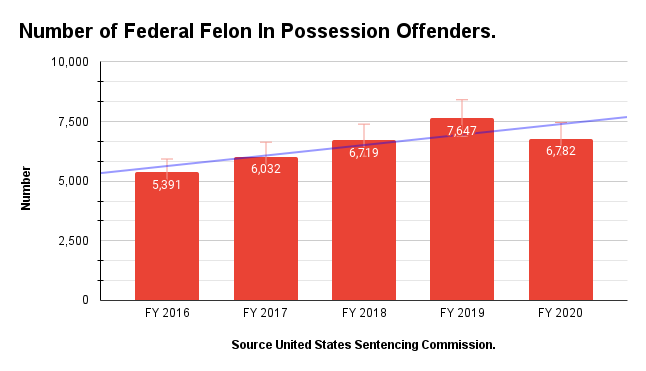
As the graph above shows, the government tracks the number of 922(g)(1) gun cases for each year. For example, the graph shows that these cases rose from 2016 to 2019. But then the numbers dropped in 2020. This was likely due to the pandemic.
More to the point, the data shows the average jail time for this crime. To illustrate, for the years 2017-2020, the average jail terms are:
- 2020: 56 months in jail;
- 2019: 58 months in jail;
- 2018: 59 months in jail; and
- 2017: 58 months in jail.
One important note about these numbers. These jail terms are averages for people charged only with a 922(g)(1) crime. If the person is also charged with a drug crime or under the ACCA, then the average jail term will be higher.
To recap, these jail terms show two things. First, 922(g)(1) cases carry real jail time. Second, the amount of jail time a person gets is constant. This gives us an idea of what to expect at sentencing. However, these numbers are only an average. They can be higher or lower depending on different factors.
Common Defense Strategies Against 922(g)(1) Gun Charges
The biggest problem in a gun case is that police may not be able to link the gun to the person. For instance:
- No knowledge or control of the gun: Police find the gun in a car, home or location where there are lots of people present;
- Bad police searches: police find the gun on the person or his property, but do not have reasonable suspicion or probable cause to search or arrest him; and
- Miranda issues: Finally, police ask the person questions without telling him he did not have to talk. If his statements are the only facts linking him to the gun, then this too can lead a judge to kick out the case.
In short, a person in this situation should check to see if he has a defense to the gun case. This happens when there is little or no evidence showing the person knew about the gun or controlled it.
Related Articles
San Antonio Federal Gun Charge Defense — Genaro R. Cortez
A 922(g)(1) conviction in federal court means real prison time — typically four to five years,
and significantly more if your record triggers the Armed Career Criminal Act. But the government
still has to prove every element of the charge. That means proving you knew the firearm existed
and that you exercised control over it. When police find a gun in a shared car, a home with
multiple occupants, or during a stop that lacked reasonable suspicion, that proof is not always
there.
If you or someone you know is facing a federal gun charge in San Antonio or anywhere in South
Texas, the time to act is now. Federal cases move fast, and early intervention matters.
San Antonio Federal Gun Defense
Talk to Attorney Genaro Cortez — Free Case Review
Serving Bexar County and all of South Texas. Bilingual consultations available. Over 20 years of criminal defense experience.
☎ Call (210) 733-7575 Request Free ConsultationWhat is a 922(g)(1) charge?
A 922(g)(1) charge is a federal crime under 18 U.S.C. § 922(g)(1) that makes it
illegal for a person with a felony conviction to possess a firearm or ammunition.
A felony is any crime punishable by more than one year in prison. If you have a
prior felony on your record — state or federal — and police find you with a gun,
the federal government can charge you under this statute. It is one of the most
commonly prosecuted federal gun crimes in the United States.
What is the penalty for a 922(g)(1) conviction?
A conviction under 18 U.S.C. § 922(g)(1) carries up to 10 years in federal prison
and a fine of up to $250,000. However, if the person has three or more prior
convictions for a violent felony or serious drug offense, the Armed Career Criminal
Act (ACCA) applies. Under the ACCA, the minimum sentence jumps to 15 years in
federal prison, with no possibility of probation or a suspended sentence. The actual
sentence will depend on the person’s criminal history and the facts of the case under
the federal sentencing guidelines.
Can a felon ever legally possess a firearm?
In most cases, no. A person convicted of a felony is permanently prohibited from
possessing a firearm under federal law. There are limited exceptions. If a felony
conviction was expunged, set aside, or pardoned — and the person’s civil rights were
fully restored — federal law may no longer apply the prohibition. However, this is
rare and depends heavily on the specific conviction and the laws of the state where
the conviction occurred. In Texas, a conviction for a felony generally means a
lifetime ban on firearm possession unless relief is specifically granted. Anyone in
this situation should speak with a criminal defense attorney before handling any
firearm.
What does the government have to prove in a 922(g)(1) case?
To convict someone under 922(g)(1), the federal government must prove three things beyond a reasonable doubt: (1) the person has a prior felony conviction; (2) the person knowingly possessed a firearm or ammunition; and (3) the firearm or ammunition traveled in or affected interstate commerce. In most cases, elements one and three are not disputed. The case usually turns on element two — whether the government can prove the person actually knew about the gun and exercised control over it. If the government cannot establish that link, the person is not guilty.
What is the difference between actual and constructive possession of a firearm?
Actual possession means the person physically had the firearm on them — in their
hand, in their pocket, or on their body. Constructive possession means the person
did not have the gun on them but knew it was there and had the power and intent to
control it. For example, a gun found in a person’s home, bedroom, or vehicle may
support a constructive possession charge even if the person was not holding it.
Constructive possession cases are harder for the government to prove because they
must show both knowledge and control. When a gun is found in a location shared by
multiple people, it becomes even harder to pin possession on any one individual.