
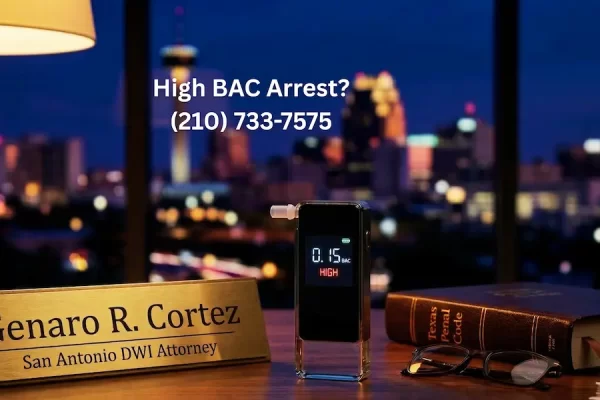
Charged with DWI .15 or More in San Antonio? Here’s What You Need to Know
A night out with friends is rarely something people associate with a DWI arrest. But if you were stopped in San Antonio and your blood alcohol concentration (BAC) came back at .15 or more, you’re now facing something more serious than a standard DWI — a Class A misdemeanor under Texas law. That distinction matters. A San Antonio DWI .15 or more charge carries higher penalties, more jail time exposure, and greater fines than a typical first-time DWI. The good news: you still have real options, and an experienced San Antonio DWI attorney can help you understand them.
Table of Contents
What Is a DWI .15 or More Charge in Texas?
Most first-time DWI cases in Texas are charged as Class B misdemeanors. This happens if the police officer thinks you are intoxicated. Or when a driver’s BAC tests at .08 or higher — the legal threshold for intoxication.
However, Texas law treats a BAC of .15 or more as a separate, more serious offense. Under Texas Penal Code Section 49.04(d), if a breath or blood test shows a BAC of .15 or more at the time of the analysis, the charge escalates to a Class A misdemeanor — with steeper consequences.
So how does a DWI arrest typically unfold? In most cases, an officer stops a driver for a routine traffic violation, such as:
- Failing to use a turn signal;
- Speeding;
- Weaving in a lane;
- Making wide turns; or
- Rolling through a stop sign.
The stop becomes a DWI investigation when the officer detects alcohol on the driver’s breath and observes poor performance on roadside sobriety tests. From there, the officer makes an arrest and requests a breath or blood sample.
If that sample returns a BAC of .15 or more, the case moves from a Class B to a Class A misdemeanor — and the stakes go up significantly.
Texas DWI Law: What the Penal Code Says About a .15 BAC
Texas Penal Code Section 49.04 governs DWI offenses in the state. Here is the relevant language:
| Tex. Penal Code Sec. 49.04 | Texas DWI Law |
| (a) | A person commits an offense if the person is intoxicated while operating a motor vehicle in a public place. |
| (b) | Except as provided by Subsections (c) and (d), an offense under this section is a Class B misdemeanor, with a minimum term of confinement of 72 hours. |
| (c) | If it is shown on the trial of an offense that the person had an open container of alcohol in immediate possession, the offense is a Class B misdemeanor with a minimum confinement of six days. |
| (d) | If analysis of a specimen shows an alcohol concentration of 0.15 or more at the time the analysis was performed, the offense is a Class A misdemeanor. |
The key provision is Section 49.04(d). It applies to drivers whose BAC tests are .15 or more — and it raises the charge to a Class A misdemeanor. For an enhanced penalty, the prosecutor must show the BAC was .15 or more at the time the test was performed — not necessarily at the time of driving. This distinction is important for your defense if there is a major time delay between the time of arrest and the time of the test.
What are the penalties for a first-time DWI in Texas
If no one was injured or killed and this is your first offense, a standard DWI is a Class B misdemeanor. The potential consequences include:
- Up to 180 days in county jail
- A fine of up to $2,000
- A combination of jail time and a fine
- Probation with a fine
Depending on your record, Texas law may also require you to pay superfines of $3,000, $4,500, or $6,000. An experienced San Antonio DWI lawyer can help you avoid these heavier fines.
Penalties for a DWI .15 or More in San Antonio
A San Antonio DWI .15 or more conviction — still a misdemeanor — can bring the following penalties:
- Up to one year in county jail
- A fine of up to $4,000
- A combination of jail time and a fine
- Probation with a fine
The offense is still a misdemeanor, and probation is still an option. But the possible jail time is meaningfully higher than a standard DWI, which is why the BAC level matters so much in Texas DWI cases.
Standard DWI vs. DWI .15 or More: Key Differences
The table below shows how a standard first-time DWI compares to a DWI .15 or more in Texas:
| Category | Standard DWI | DWI with BAC .15 or More |
| Offense Level | Class B Misdemeanor | Class A Misdemeanor |
| BAC Range | .08 but less than .15 | .15 or more |
| Max Jail Time | Up to 6 months | Up to 1 year |
| Max Fine | Up to $2,000 | Up to $4,000* |
| Probation Eligible? | Yes | Yes |
* A BAC of .015 may also trigger superfines in your case.
Your Options After a DWI .15 or More Arrest in San Antonio
Being arrested does not mean you are guilty. Depending on the facts of your case and your personal goals, you generally have two paths forward.
Option 1: Fight the Charge
To convict you of DWI, the State must prove one of the following:
- You lacked normal use of your mental or physical faculties due to alcohol, drugs, or both; or
- Your BAC was .08 or higher at the time of driving.
For the Class A enhancement specifically, the State must also show that your BAC was .15 or more at the time the test was performed. This creates real opportunities to challenge the breath test machine or blood results, the testing procedure, and the results themselves.
A strong DWI defense often starts with the video. If dashcam or bodycam footage shows you speaking clearly, walking steadily, and performing reasonably well on field sobriety tests, that evidence can contradict the BAC result — and give the jury reason to doubt the State’s case.
Option 2: Negotiate a Plea Deal
Not every driver wants a jury trial, and that is an understandable choice. A higher BAC often means more visible signs of intoxication, which makes a trial defense tougher to pursue. In those situations, working with a skilled San Antonio DWI attorney to negotiate a favorable plea deal may be the better path.
A negotiated plea can mean a shorter probation period, reduced fines, and a lighter sentence overall. An experienced attorney will evaluate the strength of the State’s evidence and advocate for the best possible outcome given your specific circumstances.
San Antonio DWI .15 Defense Attorney — Genaro R. Cortez
A DWI .15 or more arrest can upend your life. It can threaten your job, your driver’s license, your finances, and your family. But a charge is not a conviction, and you deserve a defense attorney who will take your case seriously.
Attorney Genaro R. Cortez is an experienced San Antonio DWI lawyer who handles .15 BAC cases throughout Bexar County. He will walk through the facts of your case with you, explain your options clearly, and fight for the best possible outcome — based on your goals, not a one-size-fits-all approach.
If you or someone you know has been charged with DWI .15 or more in San Antonio, do not wait. Early intervention by a knowledgeable DWI attorney can make a significant difference in how your case resolves.
What is a DWI .15 or more in Texas?
A DWI .15 or more is a Class A misdemeanor in Texas. Prosecutors use it when a driver’s BAC tests at .15 or higher at the time of the breath or blood analysis. It carries steeper penalties than a standard first-time DWI.
Is a DWI with a .15 BAC a felony in Texas?
No, unless you either had a child in the car at the time of offense or drove in a school crossing zone during the time the reduced speed limit applies to the zone. Otherwise, it is a Class A misdemeanor.
Do I have to install an Ignition Interlock Device (IID) in Bexar County if my BAC is 0.15 or higher?
Yes. In San Antonio and across Texas, judges are required by law to order an Ignition Interlock Device as a condition of bond or probation if your BAC was .15 or higher. This device requires a clean breath sample before your vehicle will start.
Can a .15 BAC charge be reduced to a regular DWI in Bexar County?
Yes, this is a possible option. Your San Antonio DWI lawyer can negotiate with the prosecutor to downgrade the charge. But it will depend on the facts of the arrest and the prosecutor handling your case.
How does a “School Crossing Zone” affect a DWI?
Under the new SB 826 (effective late 2025/2026), if you are arrested for a DWI in a school crossing zone during reduced-speed hours, the charge is automatically elevated to a State Jail Felony, regardless of your BAC. This is a much more serious charge than a standard misdemeanor.
What is the difference between a Class A and Class B DWI in Texas?
A Class B DWI applies to a first-time DWI with a BAC between .08 and .14. A Class A DWI applies to either a DWI-2nd or when the BAC is .15 or more. The Class A carries up to one year in jail and a $4,000 fine, compared to 180 days and $2,000 for a Class B.
Can I get probation for a DWI .15 or more in Bexar County, Texas?
Yes. Even with a BAC of .15 or more, probation is still available for a first-time DWI offense in Texas, as long as no one was injured or killed.
Should I fight a DWI .15 charge in San Antonio?
It depends on the facts of your case and your goals. If the dashcam video shows you performing well on roadside tests, there may be strong grounds to challenge the BAC result. An experienced San Antonio DWI attorney can evaluate whether fighting the charge or negotiating a plea deal makes more sense for your situation.
I am not a U.S. Citizen, will a DWI plea affect my ability to stay in the country?
Yes, that is a possibility. You must always consult with an immigration attorney before you accept any type of DWI or other criminal plea offer.