
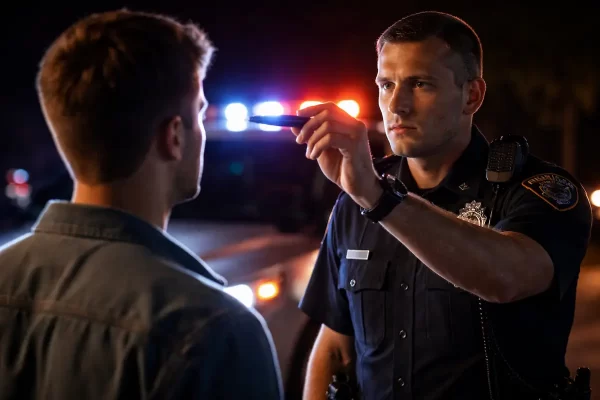
If you were pulled over and asked to follow a pen with your eyes, you just took the Horizontal Gaze Nystagmus (HGN) test — one of the most important pieces of evidence in a San Antonio DWI case. As a DWI attorney in San Antonio, I want to break down exactly how this test works, what police are looking for, and how to fight back if the test was done wrong.
Facing a DWI charge in San Antonio? Learn how Attorney Genaro Cortez defends DWI cases →
What is the HGN test?
The HGN test is the eye test San Antonio police use to check whether a driver is intoxicated. Alcohol causes a driver’s eyes to involuntarily bounce or jerk — a motion called nystagmus. Officers watch for this jerking as your eyes move from side to side.
NHTSA (the National Highway Traffic Safety Administration) officially calls it the Horizontal Gaze Nystagmus test. Along with the One-Leg-Stand (OLS) and Walk-and-Turn (WAT), it is one of three standardized field sobriety tests police use before deciding to arrest you for DWI in Texas.
The 6 Clues Officers Look for During the HGN Test
Police look for three clues in each eye — six total. They are::
- Lack of smooth pursuit — The eye bounces or jerks as it moves from center to the side.
- Distinct nystagmus at maximum deviation — When the eye is held at the far edge of vision for at least four seconds, it continues to jerk.
- Onset of nystagmus before 45 degrees — The eye begins jerking before it reaches a 45-degree angle.
If an officer finds four or more clues, they will typically conclude you are intoxicated and arrest you for DWI.
Can the HGN Test Be Wrong? Causes of False Results
The HGN test is far from foolproof. Many conditions — completely unrelated to alcohol — can cause nystagmus and lead to a false result. These include:
- Neurological conditions Neurological conditions
- Inner ear disorders Inner ear disorders like vestibular neuritis
- Certain medications Certain medications, including antihistamines, antidepressants, and anti-seizure drugs
- Fatigue or stress Fatigue or stress
- Flashing lights Flashing lights from a patrol car during the stop itself
This is important for your DWI defense in San Antonio. If you have any of these conditions, the officer may have misread the results entirely.
How San Antonio Police Must Administer the HGN Test
Texas courts require police to follow specific steps when administering the HGN test. Officers must:
- Minimize distractions, including facing you away from patrol car lights
- Ask you to remove glasses
- Check for equal pupil size and equal tracking before beginning
- Hold the stimulus 12-15 inches from your nose, slightly above eye level
- Move the stimulus smoothly and at the correct pace
- Complete all required passes before noting any clues
If the officer skipped steps, rushed the test, used poor lighting, or made other errors, those results may be challengeable.
How a San Antonio DWI Attorney Challenges HGN Evidence
Under Texas Rule of Evidence 702, drivers charged with DWI have the right to challenge HGN test results. As your DWI attorney in San Antonio, I can file a motion asking the court to review whether police followed proper NHTSA protocol. If the judge agrees they did not, the HGN results can be excluded from evidence — which is a major win for your case.
HGN test results carry significant weight with juries. Keeping bad test results out of the courtroom can be the difference between a conviction and a dismissal.
What Happens If Police Made Mistakes on the HGN Test?
The case law in Texas is clear: police must follow the standardized HGN steps. If they failed to do so, the State may not be able to use those results against you at trial. This is exactly the kind of issue an experienced San Antonio DWI lawyer will look for when reviewing your case.
Arrested for DWI in San Antonio? Let’s Talk.
DWI cases in San Antonio share three common elements — the stop, the field sobriety tests, and the chemical test. Understanding how HGN evidence fits into your case helps you and your attorney decide whether to fight the charge or negotiate a better outcome.
If police gave you the HGN test in San Antonio, I want to review how it was done. Contact the Law Office of Genaro R. Cortez, PLLC today to discuss your DWI case. Phone: 210-733-7575.
Ready to fight your DWI charge? See how the Law Office of Genaro R. Cortez can help →
Frequently Asked Questions: HGN Test and DWI in San Antonio
Can I refuse the HGN test in Texas?
Yes. In Texas, the HGN test is considered a voluntary field sobriety test. You can legally refuse to take it. However, the officer may still arrest you for DWI if they have other probable cause, and your refusal could be mentioned at trial. Speak with a San Antonio DWI attorney before making any decisions if you are stopped.
How accurate is the HGN test?
According to NHTSA research, the HGN test correctly classifies subjects approximately 88% of the time when administered alone — meaning it is wrong more than 1 in 10 times. Combined with the other two field sobriety tests, accuracy rises but still leaves significant room for error, especially when officers make procedural mistakes.
Can medical conditions cause a false positive on the HGN test?
Yes. Conditions such as multiple sclerosis, inner ear disorders, certain neurological issues, and even some prescription medications can cause nystagmus that mimics alcohol-related impairment. If you have a medical condition that could affect your eye movements, this is a critical piece of information for your DWI defense.
What is Texas Rule of Evidence 702 and how does it help my DWI case?
Texas Rule of Evidence 702 governs the admissibility of scientific evidence in court. It allows a DWI defendant to challenge whether the HGN test was administered correctly. If your San Antonio DWI attorney files a successful motion under Rule 702, the judge may exclude the HGN test results from your case — removing one of the State’s key pieces of evidence.
What should I do after a DWI arrest in San Antonio?
Contact a DWI attorney in San Antonio as soon as possible. Time matters — especially for protecting your driver’s license through an ALR (Administrative License Revocation) hearing, which has a strict filing deadline. An experienced attorney will review the HGN test results, dashcam footage, officer reports, and all other evidence to build the strongest possible defense.